
Buying AI at scale used to mean picking a model. Now it means picking where your prompts travel, who can see them, and what you pay for every token along the way. For companies whose AI spend has to pass a security review and a finance review, the gateway in the middle matters as much as the model at the end.
OpenRouter made the one-key, many-models approach popular. But enterprise buyers are asking harder questions: can a vendor prove what happens to a prompt, what happens when no approved route is available, and who will own the platform next year? This comparison looks at the main OpenRouter alternatives through that lens. Facts reflect a November 20, 2026 research snapshot.
What enterprise buyers should compare
Most OpenRouter alternatives fall into one of four types. A hosted marketplace sells access to many providers through one contract. A cloud platform sells models inside one cloud account. A bring-your-own-key gateway sits in front of provider contracts you already hold. A self-hosted proxy is software you run yourself.
Four questions separate them for enterprise use:
- Privacy evidence. Does the vendor publish proof of what handles your prompts, or a policy describing what it intends?
- Failure behavior. When no provider meets your privacy rules, is the request blocked or quietly sent somewhere else?
- Total cost. What is the platform fee, what billing base does it apply to, and do providers compete on price?
- Operating load. How many contracts, keys, invoices and patch cycles does your team own?
OpenRouter alternatives at a glance

The best OpenRouter alternatives for enterprise buyers
1. NY Token Exchange (NYTE)
NYTE is an AI marketplace announced in October 2026. Through one API, nearly 100 providers, including Google and Amazon alongside much smaller rivals, compete to serve more than 600 models, from OpenAI and Anthropic to open models such as Kimi. Companies set their rules once on NY Token Exchange: which providers are allowed, what privacy level each workload needs, and how much to spend. Every qualifying route's price is visible before a request runs.
The gateway runs on confidential hardware that publishes cryptographic proof of the exact software build handling each request, and that build does not log prompts or outputs. If no provider meets a company's privacy rules, the request is blocked rather than sent somewhere less private. The platform fee is 5.5% on text and embedding tokens with no subscription, and existing OpenAI SDK code keeps working after a change to the base URL and API key. A SOC 2 Type II audit is in progress, so it should not be described as SOC 2 or HIPAA certified.
Best for: companies that want many competing providers under one contract, with privacy their security team can verify rather than take on trust.
2. Amazon Bedrock
Bedrock offers model access inside an existing AWS account, at AWS list prices per model, with billing through the same relationship. That suits teams already committed to AWS, but buyers get one cloud's catalog at that cloud's prices. If processing location matters, review its cross-Region inference profiles carefully: AWS notes that while stored data stays in the source Region, prompts and outputs can move to other Regions during cross-Region inference. Privacy protections rest on AWS service terms rather than published proof of the software handling each request.
Best for: teams already standardized on AWS that want model spend on their existing cloud bill.
3. Google Vertex AI
Vertex AI gives Google Cloud customers model access through their existing account and billing. Like Bedrock, it offers one cloud's catalog at that cloud's prices. Location choices need care here too: Google's documentation states that requests sent to a global endpoint may be processed in any Google Cloud location and carry no data residency guarantee, so regulated workloads should use regional or multi-region endpoints. Privacy protections rest on Google Cloud service terms.
Best for: Google Cloud customers that want Gemini and partner models without adding a new vendor.
4. Portkey
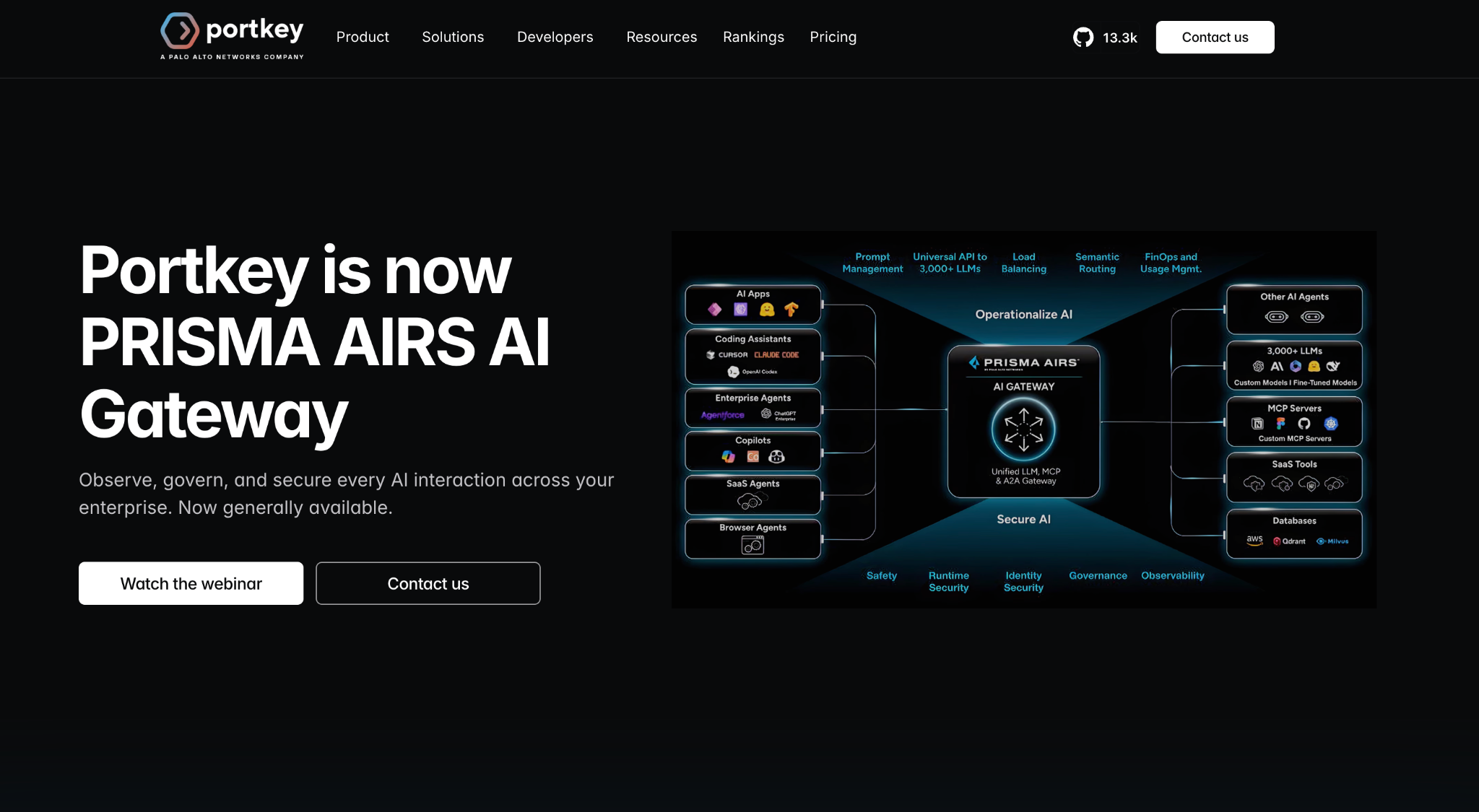
Portkey is a gateway for AI providers you contract with and pay separately. It stores provider keys and manages access through virtual keys, which centralizes control without replacing your provider relationships. Palo Alto Networks announced on May 29, 2026 that it had closed its acquisition of Portkey, and it is building Portkey into its Prisma AIRS security platform. Buyers should factor that ownership change into long-term roadmap and contract planning.
Best for: security-led teams that want central control over provider contracts they already hold.
5. LiteLLM
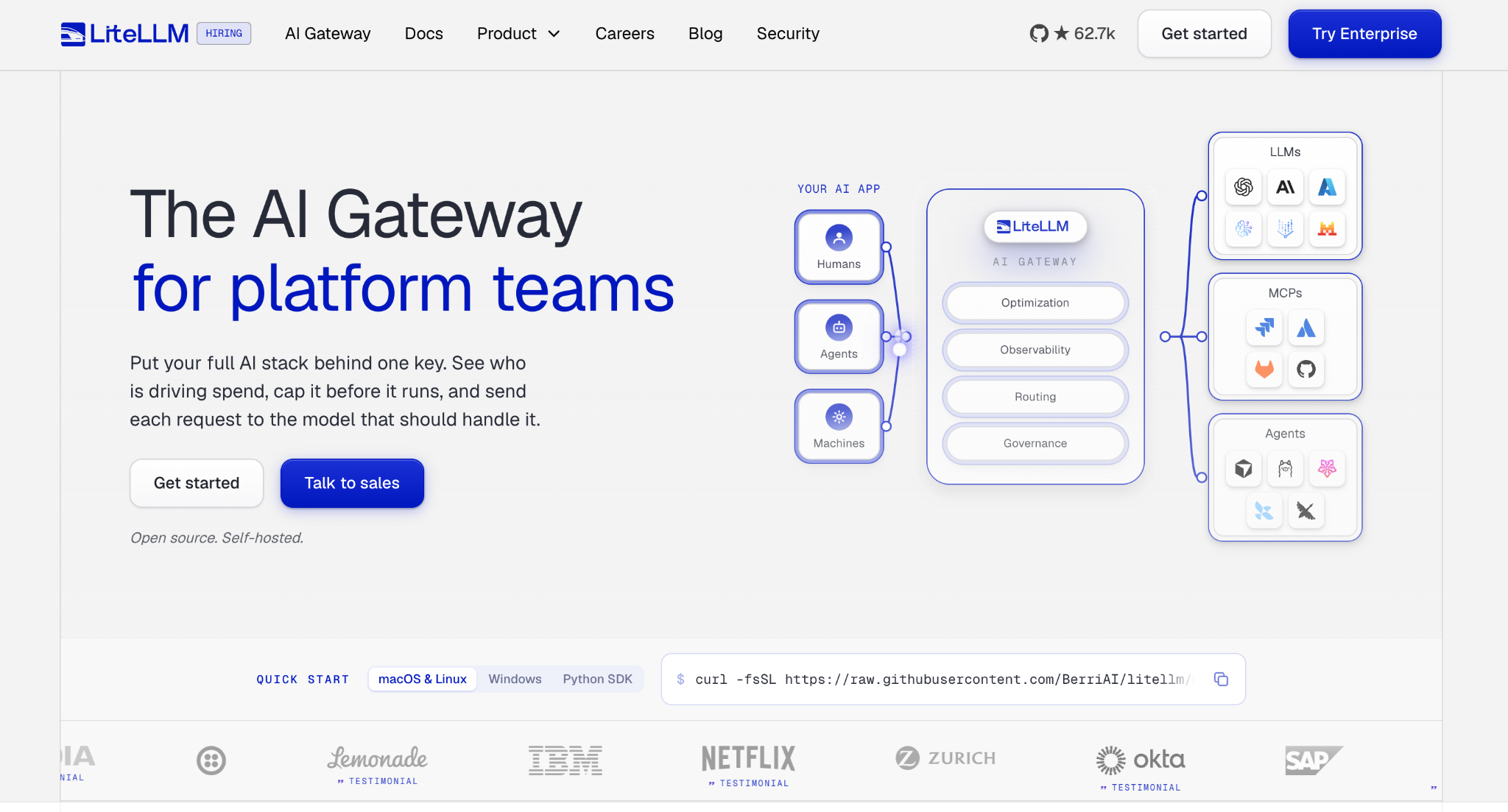
LiteLLM is an open-source proxy that your team hosts, patches and secures, with a separate contract for every provider behind it. That control comes with supply-chain responsibility: Datadog Security Labs documented that LiteLLM releases 1.82.7 and 1.82.8, published to PyPI on March 24, 2026, shipped malicious code as part of a broader supply-chain campaign. Teams choosing LiteLLM need pinned versions, verified package hashes and a fast patch process.
Best for: engineering teams with the capacity to run, monitor and secure their own gateway infrastructure.
OpenRouter: the baseline these alternatives replace
OpenRouter is the closest model for what most buyers want: one API key and one endpoint for hundreds of models. Its privacy protections rest on policy, including a no-logging default and zero-retention routing, rather than on published proof of the software handling each request.
Fees apply to credit purchases rather than tokens: 5.5% on the Standard plan and 8% on Business, according to OpenRouter's pricing page. In-region EU and US routing is reserved for the Business and Enterprise plans, so a company that needs EU routing pays the higher rate. Stripe announced on August 19, 2026 that it had agreed to acquire OpenRouter.
How to choose
Start with one representative workload rather than a platform-wide migration. Fix the evaluation set, the approved provider list, the privacy level and a budget cap, then run each shortlisted option against the same criteria.
Measure accepted-output rate, cost per accepted result, latency and policy failures. Test the case where no approved route is available and confirm the request is blocked, not rerouted. Check that tool calls, streaming and caching behave as expected after switching. Before moving production traffic, have legal confirm the model provider terms behind each approved route, including how long inputs are retained and whether they can be used to improve the model.
The bottom line
Each option solves part of the problem. Cloud platforms keep spending inside an existing account, a bring-your-own-key gateway centralizes control over contracts you already hold, and a self-hosted proxy offers full control in exchange for full responsibility. For companies that want competing providers, one contract and privacy they can verify rather than take on trust, a hosted marketplace with published proof is the strongest fit.
FAQ
Is NYTE a crypto or securities exchange?
No. NYTE sells AI inference, billed by the token.
Does "New York" mean data stays in New York?
No. New York is the market's name. Where requests run is set by each company's route rules, and routing can be restricted to US-hosted providers.
Is NYTE SOC 2 certified?
Not yet. A SOC 2 Type II audit is in progress, and NYTE should not be described as SOC 2 or HIPAA certified.
How hard is it to move from OpenRouter?
For most teams, existing OpenAI SDK code keeps working after changing the base URL and API key. Test tool calls, streaming and caching before moving production traffic.
Is the gateway open source?
No. Its code is public for review under the Business Source License 1.1, which makes it source-available rather than open source. Each version converts to the Apache License 2.0 four years after publication.
The opinions on this page are for general information purposes only and do not constitute legal advice on which you should rely.


